The plain answer first: photography is not permitted inside Latter-day Saint temples, and the sealing ceremony itself is never photographed. Coverage of a temple wedding centers on everything around that ceremony: the exit through the temple doors, portraits on the temple grounds, and the celebration afterward, where a ring ceremony often gives every guest a moment to witness. None of this is a limitation to work around; it's a structure to plan well, and a well-planned temple wedding day photographs as completely as any other. We've photographed many of them across Utah, and this guide explains how the day works, what the policy actually says, and how we build coverage that honors the ceremony and includes everyone you love, whatever their faith.
How photography works at an LDS temple wedding.
What is and isn't photographed on a temple wedding day, how the exit and the grounds become the heart of the coverage, and how to plan a day that includes everyone you love.
What's in this guide.
How does a temple wedding actually work?
For everyone planning around one, members and not: a temple wedding centers on a sealing, the ceremony in which a couple is married in a Latter-day Saint temple. It takes place in a sealing room inside the temple, and it is attended only by guests who hold a current temple recommend; in practice that means active adult members of the church. Family and friends without a recommend, whatever their faith, wait outside the sealing rather than attending it.
That structure shapes the whole day. The sealing is often midday, the reception is typically a separate event in the evening at another location, and the hours between belong to portraits, travel, and family. If you're a parent or friend coming to a temple wedding from outside the church, the day will likely include a wait during the ceremony and then a full welcome into everything after it, and a thoughtful couple (with a thoughtful photographer) plans that experience deliberately. The sections below cover exactly how.
Couples planning their own day will also work with their temple's scheduling office on the appointment itself. That office is the authority on everything that happens at the temple, and the published guidance from the church, titled Planning Your Temple Wedding, is the source we defer to throughout this guide.
What photography is and is not allowed?
The policy, plainly. Photography is not permitted inside the temple. That applies to everyone: professional photographers, guests, and phones alike. The sealing ceremony is not photographed, by anyone, ever. This isn't a rule a photographer can ask around or a venue restriction with a workaround; it's a matter of the sacredness of the space, and the right posture toward it is simple respect.
Per the church's published guidance, rings may be exchanged in the sealing room at the couple's discretion, and many couples also hold a separate ring ceremony at the reception, which gives family and friends who weren't in the sealing a moment to witness, and gives us a beautiful, fully photographable version of the exchange. More on that below.
Everything outside the temple doors is photographable, and that's where the day's coverage lives: the exit, the greetings, the portraits on the grounds, and the entire celebration afterward. Couples sometimes arrive at this policy expecting to feel shortchanged and end their day with one of the fullest galleries we deliver, because the structure concentrates the emotion into moments that photograph wonderfully.
The sealing is not photographed. Everything outside the doors is, and it is plenty.
Why is the exit the emotional center of the day?
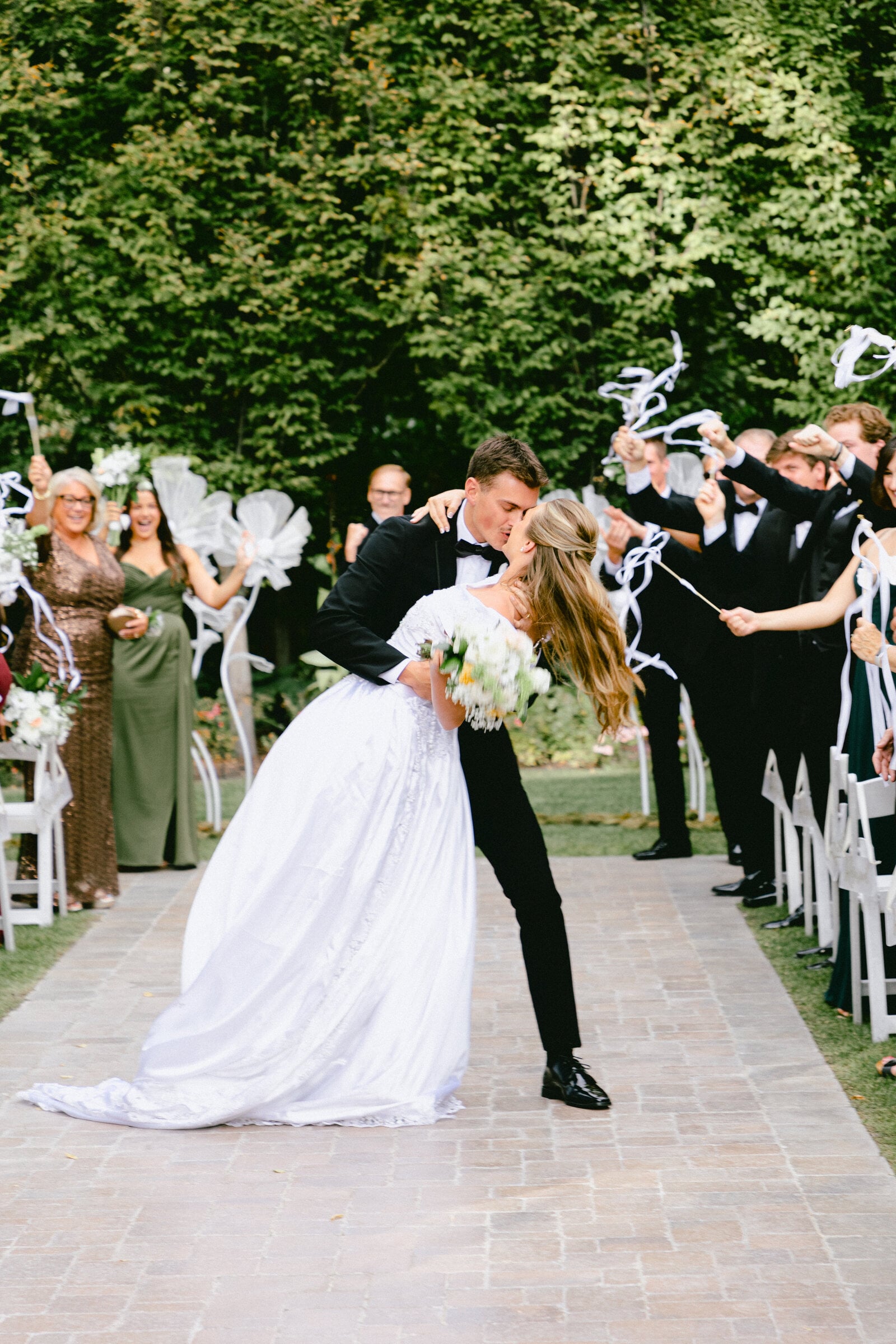
Think about what the exit actually is. The two of you walk out of the temple doors married, and it is the first time anyone outside the sealing room sees you that way. For parents and friends who waited outside, it is more than a photo opportunity; it is the moment they meet the marriage. The faces at a temple exit (a mother seeing her son, a grandmother's hands going up, friends cheering from the steps) carry the emotional weight that an aisle recessional carries at other weddings, and often more, because some of these people have been waiting an hour to see you.
We treat the exit as the centerpiece of temple-day coverage and plan it like one. Before you come out, we're already positioned: we've gathered the waiting family and friends where the view is right, chosen the angle on the doors, and made sure the people who matter most are where they'll be in frame. When the doors open we photograph the walk-out, the first reactions, the embraces, and the wave of greetings that follows, and we let that sequence breathe rather than rushing you to portraits.
One planning note: tell your guests the expected exit time, and tell us if the sealing schedule shifts. The exit happens once, without a rehearsal, and the difference between a good exit photograph and a great one is mostly whether everyone, photographer included, was ready for the doors.
Planning portraits on the temple grounds
Temple grounds are kept beautiful, and they're a meaningful backdrop in the photographs for the same reason the day is structured around the building. After the exit and greetings, we move into portraits: the two of you, families, and friends, with the temple in frame. Allow 30 to 60 minutes for this block. Less than thirty rushes the family groupings; more than sixty starts to wear on grandparents and small children who have already waited through a sealing.
We shoot the grounds handheld and light on equipment, which suits both the setting and the pace of the day. Policies on photography equipment and where it may be used on the grounds can vary from temple to temple, so confirm any equipment rules with your temple's scheduling office when you book your sealing time; we're happy to adapt to whatever your temple asks, and knowing it in advance is all we need.
Light on the grounds works like light everywhere: morning and late afternoon are gentle, midday is the hardest hour, and the building itself casts deep shade on one side and bright reflection on the other as the sun moves. We can't always choose the sealing time, but we can choose where on the grounds to work for the hour we get, and that's a problem we solve in advance for your specific temple, season, and time of day. If the schedule allows any flexibility, it's worth asking us before the appointment is fixed.
Planning for family who are not attending the sealing
This is the part of the day that deserves the most care, and it's the part national wedding content never covers. Family and friends without a temple recommend, which often includes beloved parents, siblings, and lifelong friends, wait outside while the sealing takes place. How that wait feels is something you can shape. The single best thing you can do is assign someone warm to host them: a family member or friend who knows the temple, can welcome people as they arrive, keep everyone oriented to the timing, and gather the group toward the doors as the exit approaches.
Tell your waiting guests in advance what the day will look like, kindly and plainly, so nobody is surprised at the curb. Something as simple as a note with the invitation: where to be, when the exit is expected, and that the celebration afterward is where everyone is together. In our experience, people are gracious about the wait when they understand it and stung mostly when they weren't told.
We often photograph through that window. While the sealing happens, we make frames of the gathered family on the grounds, candids of the waiting and the reunions as people arrive, and the quiet details of the day. Those photographs matter twice: they fill the gallery's account of the hours we can't otherwise cover, and they honor the people who spent that hour waiting for you. Then the ring ceremony at the reception closes the loop. It's the moment built precisely so that everyone, recommend or not, witnesses an exchange of vows or rings, and we photograph it with the same weight other weddings give the ceremony itself.
Assign someone warm to host the wait. It is the kindest hour of planning you will do.
Building the temple-day timeline
The skeleton of the day: arrive and stage before the sealing, the sealing itself (unphotographed, with waiting guests hosted outside), the exit, greetings, 30 to 60 minutes of portraits on the grounds, travel, and then the evening reception with the ring ceremony placed where it gathers the whole room. The two blocks that get underestimated are travel and the gap. Utah receptions are often a real drive from the temple, and the afternoon hours between portraits and reception need a plan, even if the plan is deliberately nothing: rest, food, and getting off your feet.
Place the ring ceremony early in the reception rather than late. Early, it functions as the ceremony moment for everyone who wasn't at the sealing, it catches guests fresh, and at many receptions it can land while there's still natural light. We'd sequence it before dinner at most receptions: entrance, ring ceremony, then the evening unspools normally through dinner, toasts, and dancing.
On coverage hours: a temple sealing with an evening reception is a two-part day with a long gap, and running continuous coverage across the whole arc is rarely the best use of a collection. We've written a full guide on matching coverage hours to this exact day shape, and the honest summary is that well-placed hours beat more hours. Tell us your temple, your reception venue, and your sealing time, and we'll map the coverage with you; after photographing temple wedding days across Utah since 2014, the shape of the puzzle is one we know well.
Asked and answered.
Can a photographer go inside the temple? +
No. Photography is not permitted inside Latter-day Saint temples, and the sealing ceremony is not photographed by anyone, professional or guest. Coverage of a temple wedding begins the moment the couple walks out the doors, and a photographer experienced with temple weddings plans the day so the exit, the grounds portraits, and the celebration carry the gallery.
What do family and friends without a temple recommend do during the sealing? +
They wait outside the sealing, often gathering on the temple grounds, since only guests with a current temple recommend may attend. The kindest plan assigns a host to welcome them, keep them oriented to the timing, and gather them for the exit. Many couples also hold a ring ceremony at the reception so those same family and friends witness a vow moment of their own.
When does the ring exchange happen at a temple wedding? +
It can happen in both places. Per the church's published guidance, rings may be exchanged in the sealing room at the couple's discretion, and many couples also hold a separate ring ceremony at the reception. That reception ring ceremony is the moment that includes every guest, and it is one of the most photographed parts of a temple wedding day.
Other planning guides.
The questions to ask before you book a wedding photographer.
A short guide for couples comparing photographers. Twelve questions, plus what to listen for in each answer.
How to build a wedding-day timeline that actually photographs.
A practical guide to building a wedding-day timeline that works for the family, the venue, and the light. Sample timelines included.
What wedding photography costs in Utah, and why.
An honest look at the Utah market: what the price tiers actually buy, what drives the number, and where to be careful at the cheap end.
How many hours of wedding photography do you actually need?
Four, six, or eight hours, mapped honestly to the most common Utah wedding-day shapes, including when fewer hours is genuinely enough.
The first look: what it changes, and how to decide.
First look or aisle reveal. What each choice does to your timeline, your light, and your portraits, with no dogma either way.
Utah wedding light, season by season.
How the light actually behaves here: canyon shade that ends early, brutal summer noon, long fall bench light, and winter receptions that run on flash.
Six months out: the wedding checklist that actually matters.
What to actually have done six months before your wedding, from the vendor who watches what happens when it wasn't. Three non-negotiables, the photo-critical decisions, and what to stop worrying about.
Wedding colors that photograph beautifully (and the ones that fight the camera).
A working photographer's chapter on color: the skin-tone rule, what Utah light does to a palette season by season, the combinations we reach for, and the ones that fight the camera.
What a Utah wedding actually costs in 2026.
The median, the mean, and the category-by-category ranges we actually see in our market, including the Utah-specific factors no national cost guide accounts for.
How to have a beautiful Utah wedding on any budget.
Three fully worked Utah budgets (roughly $14,000, $24,000, and $45,000), the allocation percentages behind them, and the five mistakes that quietly cost couples the most.
Do you need a wedding videographer? An honest answer from the photo side.
We don't sell video, so we have no stake in your answer. What film gives you that photographs can't, what it costs in Utah, and when we'd honestly tell you to skip it.